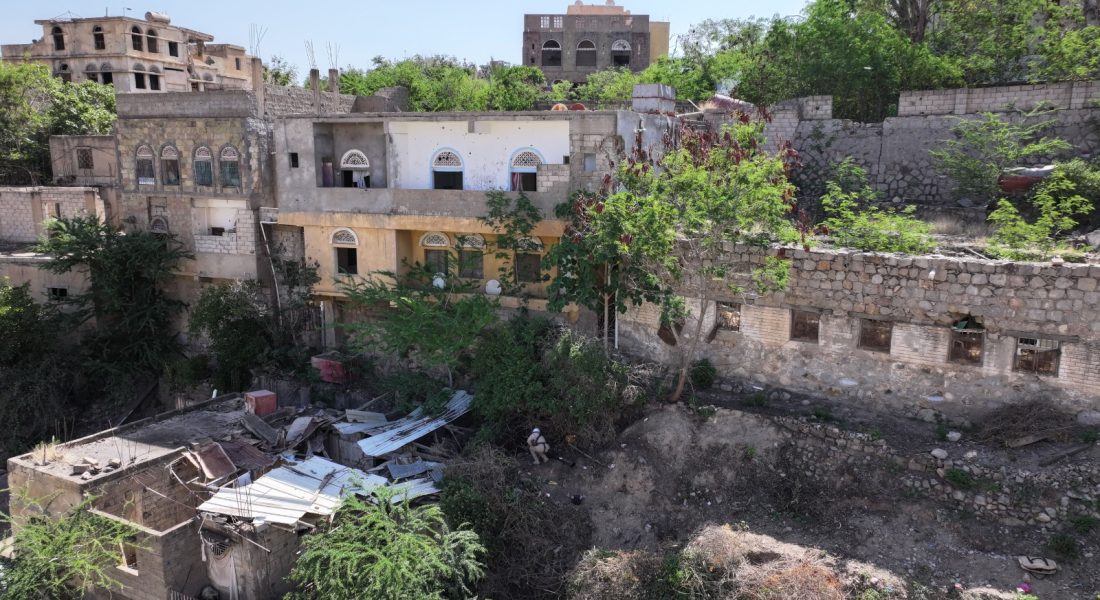
Residents are gradually returning to the Sila al-Da’wa neighbourhood in Salah district, east of Yemen’s embattled Taiz Governorate, following ongoing clearance operations by Project Masam teams after years of contamination from landmines, improvised explosive devices, and other explosive remnants of war.
For several years, contamination across residential streets, homes, and public areas forced many families to leave the neighbourhood due to safety concerns. Local residents say the presence of explosive hazards affected daily movement and prevented displaced families from safely returning to their homes.
Project Masam teams are continuing clearance operations in the area following repeated appeals from residents to remove explosive contamination from residential areas and around essential infrastructure.
Abdullah Mohsen al-Shara’i, head of the Sila al-Da’wa neighbourhood, told Project Masam’s media office that residents had lived under constant threat since 2019 because of widespread contamination from landmines and improvised explosive devices placed in residential areas and near water tanks.
According to al-Shara’i, several civilians were killed or injured during attempts to return to their homes, including women and elderly residents. Some survivors sustained amputations and permanent injuries caused by explosions inside the neighbourhood.
He explained that the arrival of Project Masam teams helped improve confidence among residents as clearance operations progressed, particularly among children who had spent years living in fear because of explosive remnants scattered throughout the area.
Engineer Alaa Abdo Dahmash, leader of Project Masam Team 33, said the team began operations in the Sila al-Da’wa neighbourhood on 1 December 2025 following requests from residents and local community leaders because of widespread contamination.
Dahmash explained that the team has so far cleared more than 3,000 square metres of land and recovered more than 45 unexploded shells, two improvised explosive devices, eight anti-personnel mines, and two hand grenades.
According to Dahmash, engineering teams have secured approximately half of the neighbourhood, while additional surveying and clearance operations are still required before residents can safely return to all parts of the area.
Khaled Abu al-Aziz al-Zariqi, a resident of the neighbourhood, described previous years as a period marked by fear and repeated incidents caused by explosive contamination. He said mines damaged homes and residential infrastructure and caused civilian casualties, including among children.
Al-Zariqi added that daily life has gradually started returning to the neighbourhood as clearance operations continue, expressing hope that the entire area will soon be declared safe so displaced residents can return permanently.
Project Masam teams continue humanitarian mine clearance operations across several Yemeni governorates to remove landmines and explosive remnants of war and improve civilian safety in affected communities.