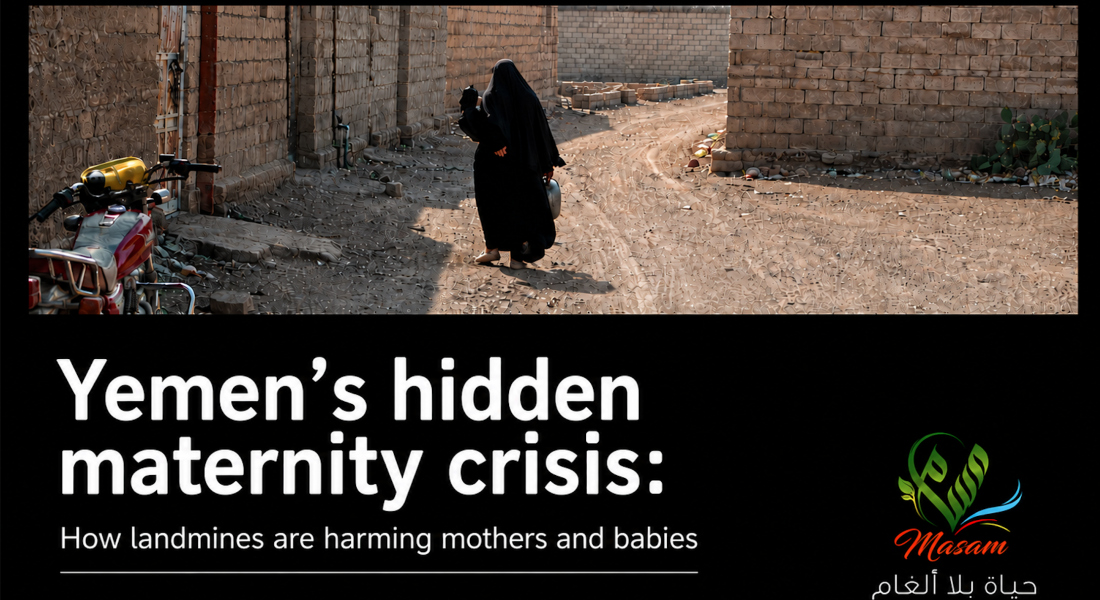
Explosive contamination in Yemen is placing pregnant women, mothers and babies at risk far beyond direct mine incidents, with Project Masam field evidence showing landmines and other explosive hazards restricting access to maternity care, water, food and livelihoods.
In parts of Taiz, Project Masam field data records journeys to healthcare facilities that could otherwise have taken around 10 minutes stretching to as long as eight hours, as families were forced onto difficult mountain routes to avoid contaminated roads.
Project Masam teams have also conducted clearance operations on access routes serving 73 health facilities and maternity units in Taiz, while field reports document mines, booby traps and unexploded ordnance restricting ambulance movement and access to vaccination and emergency treatment.
The findings are published today in Yemen’s hidden maternity crisis: How landmines are harming mothers and babies, a new Project Masam investigation into a largely undocumented dimension of Yemen’s explosive contamination.
Drawing on operational data, field investigations, interviews with demining personnel and the experiences of survivors and affected families, the report examines how contamination affects women and babies through direct injury as well as disrupted healthcare, unsafe roads, restricted access to water and agricultural land, displacement and the economic consequences of mine incidents within families.
One of the cases documented is that of Mohammadah Mohammed Abdullah, who was pregnant when she stepped on an anti-personnel mine after returning to her home in Al-Musanna, Al Hudaydah, in October 2021. Mohammadah survived, but both of her lower limbs were amputated and she lost her unborn child.
Beyond direct casualties
The investigation finds that the relationship between explosive contamination and maternal health is considerably wider than cases in which pregnant women are themselves involved in mine incidents.
Along Yemen’s West Coast, Project Masam personnel have recorded communities travelling hundreds of kilometres to reach healthcare because considerably nearer facilities could not be reached safely.
Contamination has also affected access to wells, pumping stations, water tanks and agricultural land. These restrictions have particular implications for pregnant and breastfeeding women in communities already facing severe pressure on healthcare, nutrition and household livelihoods.
Agriculture is central to that picture. FAO estimates that 73% of Yemen’s rural population relies on agriculture for livelihoods and 87% of rural women participate in agricultural production or livestock keeping. Where land cannot be cultivated safely, the effects can extend directly to household food supplies and income.
The report also examines the consequences of displacement and return. Families returning home can encounter mines, IEDs and unexploded ordnance on roads, around homes, on farmland and near essential infrastructure, potentially preventing the resumption of everyday life even after displacement has formally ended.
An impact that remains largely undocumented
The investigation identifies a substantial evidence gap around these indirect effects.
Mine casualty data can record a woman killed or injured in an explosion. It is far harder to capture a pregnancy placed at risk because a road to a health facility is contaminated, a mother unable to reach a water source, or a household losing the agricultural income needed to pay for food and healthcare.
Commenting on the findings, Project Masam Managing Director Ousama Algosaibi said: “After eight years of this work, I have seen what these words “landmines” and “explosive contamination” actually mean for families. They mean a woman losing her legs and the baby she was carrying. They mean a mother knowing there is a hospital nearby but being unable to take the road to reach it. They also mean families having to choose whether to risk a mined road to find water, food or medical care.
“For those watching Yemen from thousands of miles away, I want them to imagine that for a moment: Imagine expecting a baby and knowing that the road to your maternity hospital may be mined. Imagine bringing a newborn home to a place where you cannot be certain that the path to your well, your farm or even your own front door is safe.
“This is the scale of what Yemen’s mothers are living with. A landmine can take the life of an unborn child in an instant, and it can also shape whether another child is born safely at all. After everything I have witnessed in Yemen, that is one of the cruellest realities of this contamination.”
The report calls for the wider effects of explosive contamination on maternal and newborn health to be considered in humanitarian assessment and Mine Action planning, including the prioritisation of clearance around healthcare routes, water infrastructure, agricultural land and communities experiencing displacement and return.
Read the full report: Yemen’s hidden maternity crisis: How landmines are harming mothers and babies [PDF]