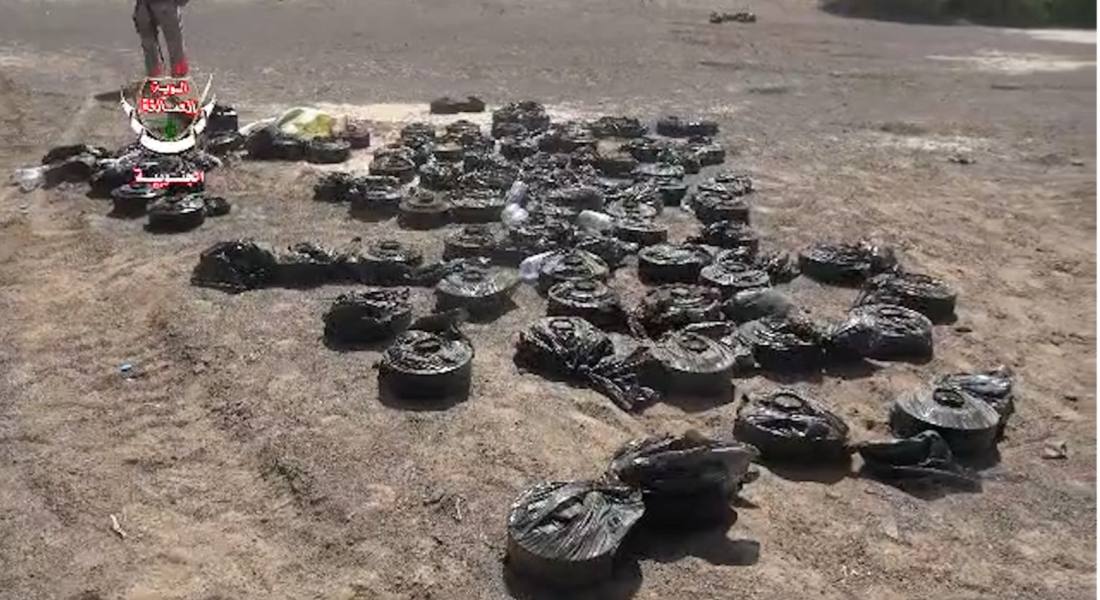
A Yemeni rights organisation has estimated that more than 300,000 anti-personnel mines are present across multiple areas of Taiz Governorate and Yemen’s West Coast, as renewed mine-laying and shifting frontlines deepen the explosive threat facing civilians.
Yemen’s landmine crisis has developed over more than a decade of conflict. Houthi forces seized Sana’a in September 2014 and the war escalated further in 2015, with anti-personnel and anti-vehicle mines and IEDs subsequently documented across multiple affected areas.
The threat changed sharply again in September 2026, when Houthi forces advanced through western Taiz and along the Red Sea Coast towards Mokha and Bab al-Mandab. A government counter-offensive in early October retook several areas, exposing fresh contamination left behind as control shifted.
By 10 October, Project Masam had documented newly laid anti-tank mine belts in recently retaken areas, with footage showing tightly spaced rows of mines across routes and open ground in Taiz and along the Red Sea Coast, including locations previously subjected to humanitarian clearance.
The estimate of more than 300,000 anti-personnel mines across Taiz and the West Coast was published by RASD Organization for Rights and Freedoms in a new report examining landmine contamination and civilian casualties in western Yemen. RASD said the figure was based on information gathered across several affected areas and represents an initial regional estimate rather than a count of mines laid during the report’s three-month monitoring period.
The organisation documented 123 landmine casualties between 1 August and 31 October 2026, including 41 people killed and 82 injured, with children accounting for the largest proportion of victims.
RASD also accused Houthi forces of using 27 schools for the manufacture and storage of landmines during the past three months, raising further concern over the use of civilian infrastructure in areas affected by the latest escalation. The report said mines had been identified around residential communities and civilian facilities, including public roads, schools, health centres, grazing areas and water wells, restricting civilian movement and access to essential services.
RASD called for an end to mine-laying in populated areas and around civilian infrastructure, the destruction of existing stockpiles and the disclosure of accurate minefield maps and coordinates to support clearance. It also called for an independent international investigation into alleged violations.
Commenting, Project Masam Managing Director Ousama Algosaibi said the estimate of more than 300,000 anti-personnel mines in Taiz and the West Coast should be viewed alongside the fresh contamination now being documented as frontlines move.
“More than 300,000 anti-personnel mines concentrated across these areas would represent an extraordinary threat to civilians, and we are already seeing the human consequences. Children are being killed and injured by explosive contamination in places where families need to live, move, farm and access essential services.”
Algosaibi added reports concerning the use of schools for mine production and storage were particularly alarming given Project Masam’s own evidence of increasingly sophisticated, locally produced explosive devices.
“Project Masam has documented locally manufactured anti-personnel and anti-tank mines and IEDs, including devices whose design and technology continue to evolve. The reported use of schools to support the manufacture or storage of these weapons is deeply disturbing. Schools are civilian spaces for children, not facilities for producing weapons that may later kill or maim them.”
Algosaibi has repeatedly warned that renewed Houthi mine-laying is recontaminating areas already subjected to humanitarian Mine Action, including locations along the Red Sea Coast where Project Masam footage has shown newly laid anti-tank mine belts following recent changes in territorial control.
Earlier estimates suggested that between one and two million mines may have been laid nationwide since the conflict escalated. The new RASD estimate suggests that anti-personnel mine contamination in Taiz and the West Coast may be far more extensive than previously understood, while Project Masam’s October footage confirms that fresh mines are still being laid as frontlines shift.
For Mine Action personnel, extensive legacy contamination is now being compounded by fresh mine-laying, increasingly sophisticated locally produced devices, limited minefield records and tighter operational access. Survey, emergency response and clearance requirements are therefore continuing to change alongside the conflict.