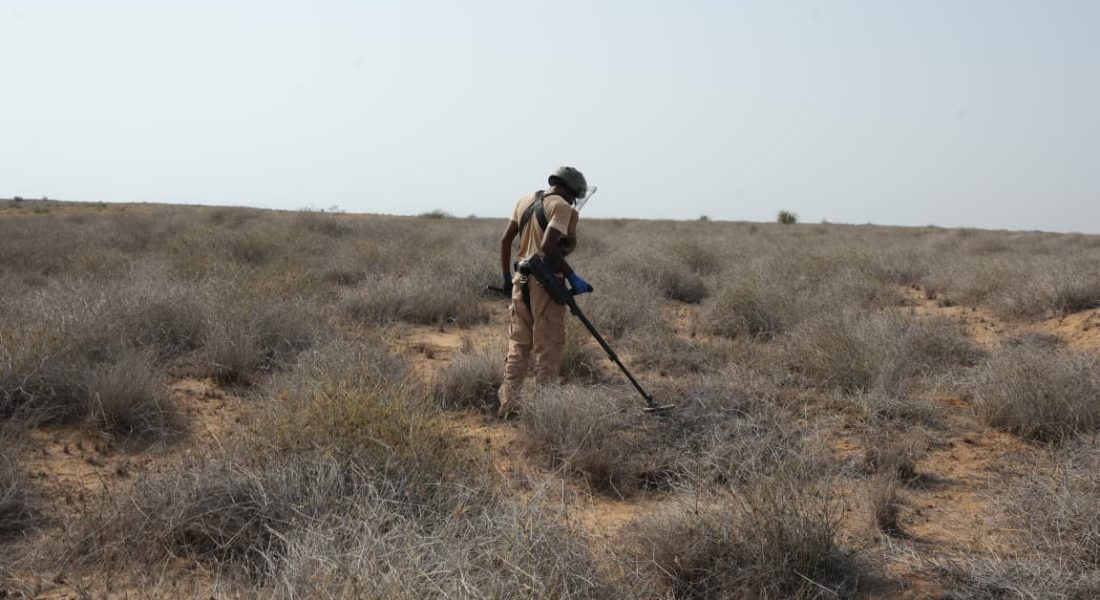
Renewed mine-laying in Taiz, Lahj and parts of Yemen’s Red Sea Coast is adding fresh explosive contamination to areas already affected by years of landmines, improvised explosive devices (IEDS) and unexploded ordnance (UXO).
Since September, Yemeni rights organisations, international agencies and Project Masam have documented new hazards on agricultural land, roads, hills and ground affected by shifting frontlines, including areas that had previously undergone humanitarian clearance.
Evidence of renewed contamination
On 25 November, the Yemeni Network for Rights and Freedoms reported continued Houthi mine-laying in Taiz and Lahj between 17 and 24 November. Mine-laying was among 1,212 violations against civilians and civilian objects that the organisation said it had documented during the week, together with shelling, sniper attacks, drone attacks, incidents affecting displaced people and medical personnel, and severe restrictions on civilian movement. Around eight civilians were reported killed and 52 injured, including 20 children.
The Network had already documented mine-laying between 1 September and 29 October on agricultural land, hills, main and secondary roads and in areas into which Houthi forces had recently expanded. Its wider reporting for the period recorded 189 civilian deaths and 281 injuries from shelling, sniper fire and landmines, alongside substantial displacement from Taiz.
Project Masam has also documented fresh contamination in areas where territorial control has changed. Footage recorded in October from recently retaken areas of Taiz and the Red Sea Coast showed newly laid Houthi anti-tank mines positioned in dense belts across routes and open ground. Some of those locations had previously undergone extensive humanitarian clearance.
Other Yemeni organisations have warned about the wider scale of contamination. RASD Organization for Rights and Freedoms estimated in November that more than 300,000 anti-personnel mines were present across parts of Taiz and Yemen’s West Coast. The figure refers to the organisation’s estimate of regional contamination rather than mines newly laid during the latest escalation. RASD also documented 123 landmine casualties between 1 August and 31 October, with 41 people killed and 82 injured. Tragically, children accounted for the largest proportion of those casualties.
Earlier this year, Save the Children reported that 45 children had been killed or injured by landmines and UXO during the first half of 2026, including 20 fatalities. Its analysis of Civilian Impact Monitoring Project data found that children in Yemen were more than three times as likely as adults to be killed or injured by these hazards.
United Nations (UN) agencies have continued to describe explosive contamination as a significant part of Yemen’s humanitarian crisis. The UN Mine Action Service, known as UNMAS, meanwhile, has identified landmines and other explosive remnants of war along roads, agricultural land, coastal areas and access routes as a continuing danger to civilians and humanitarian personnel. Economic pressure also contributes to exposure as people return to contaminated areas for farming, grazing, fishing and everyday movement.
During the latest escalation, the UN’s Children’s Fund (UNICEF) reported mass displacement and disruption of essential services in Taiz and Lahj, with more than 800,000 people in Taiz reportedly cut off from humanitarian assistance by late October. UNICEF and its partners had provided explosive ordnance risk education to more than 79,000 people as part of the response by 9 November, it said.
Renewed mine-laying is worsening an already severe contamination problem, adding new hazards to roads, farmland and access routes while communities continue to live and move through areas affected by years of conflict.
Recontamination and civilian access
The effects of recontamination are particularly serious where clearance has allowed communities to resume using land and infrastructure. Farmers may have returned to cultivated fields, families may again be travelling along local roads, and grazing areas, water sources or routes to markets and health facilities may have been brought back into regular use.
We know from experience that where new contamination is known, civilians may stop using a road or field and divert instead onto secondary tracks or open ground that may not themselves have been surveyed; where mines have been laid but not yet reported or identified, people may continue using an area without knowing that its hazard status has changed.
That risk is compounded by the extent to which everyday life in Yemen depends on continued access to land and movement between communities. Around 60 per cent of Yemeni households rely at least partially on agriculture for their livelihoods, while water sources, markets, healthcare and schools may all require regular movement beyond the immediate community.
In Taiz, these pressures were already acute before the latest escalation that began in August 2026. The city and surrounding districts have lived with severe restrictions on movement and access since the conflict intensified in 2015, while landmines and IEDs have contaminated roads, farmland, water sources and other civilian areas. Water access has been particularly fragile: a 2025 UN Panel of Experts report found that only 21 of 91 public wells were located in government-controlled territory and that water trucking was meeting no more than 15 per cent of demand. Food insecurity was also among the most severe in Yemen, with 10 of Taiz’s 16 districts already at IPC Phase 4, or Emergency level (the second-highest level of acute food insecurity on the international IPC scale) before the current fighting.
Sadly, the renewed fighting has compounded those existing pressures. Indeed, since early October, road closures and insecurity have sharply reduced the movement of people and commercial supplies into Taiz, while new mine-laying along roads and access routes has added further hazards to an already heavily contaminated environment. The Yemeni Network for Rights and Freedoms reported in November that the number of vehicles entering Taiz had dramatically collapsed by more than 98 per cent since 4 October, from around 8,000-10,000 vehicles per day to no more than 150.
UN agencies have meanwhile reported food and fuel prices rising sharply, water production falling by around half and humanitarian access deteriorating to the point that the UN World Food Programme (WFP) was unable to reach more than 600,000 people in Taiz who depend on assistance.
Taiz’s mountainous geography leaves little room for easy diversion when a road or track becomes inaccessible. The city lies in Yemen’s highlands at the foot of Jabal Sabir, while much of the surrounding governorate is characterised by steep mountain ranges, valleys and rugged terrain – meaning civilian and commercial movement is often channelled along a limited network of existing roads and tracks. Where one of those routes is closed, damaged or newly contaminated by mines, simply moving around it may not be possible: alternative tracks may be difficult to reach, unsuitable for vehicles or themselves unsurveyed. Those same corridors are also used to move food and fuel, reach healthcare and carry humanitarian supplies.
For communities living with these everyday constraints, recontamination can mean losing access to roads, farmland or water sources they had already regained after clearance.
Operational implications for Mine Action teams
For Project Masam, recontamination can mean sending teams back to ground they have already surveyed or cleared, sometimes after communities have returned and resumed using it. A new local report of mine-laying changes what we know about that area and can require fresh community liaison, non-technical survey and, where necessary, technical survey before clearance can begin again.
Existing records remain useful because they provide information on the earlier contamination pattern and the work already completed. Newly laid devices may follow different patterns and may have been placed after the last survey or clearance task. Changes in territorial control, civilian movement and the wider security situation also have to be taken into account before teams can deploy.
The absence of comprehensive minefield records continues to complicate clearance across Yemen. Despite repeated calls from UN agencies, the wider international community and Mine Action organisations including Project Masam through its #HandInTheMaps campaign, Houthi forces have not provided coordinates or other detailed information on the location of mines they have laid. Teams are therefore often working without the baseline information that could help identify contaminated areas, a problem made more difficult when new mines are laid in locations that have already been surveyed or cleared.
Project Masam’s weekly operational reporting since September shows how closely clearance activity is tied to the wider security environment. Between 19 and 25 September, several of our demining teams were temporarily stood down because of conditions along the West Coast, while community liaison in Midi in Hajjah in northern Yemen identified additional hazardous areas requiring technical survey. Operations continued at a reduced pace during the following reporting period, with teams prioritising reports of mines and UXO from local communities as security conditions permitted.
By early October, several teams in Midi had been stood down and mechanical clearance using Project Masam’s PT300 had been suspended. Later that month, some teams were working on alternating rotations because of the security situation.
Manual clearance, non-technical survey, explosive ordnance risk education (EORE) and emergency response have continued in multiple locations during November. Teams have also continued opening or assessing new task sites, including Al-Naseem farm east of Midi, and Project Masam’s Special Tasks Teams (STT) maintain emergency response coverage across Aden, Al Dhale, Abyan, Lahj, and sections of Taiz.
Operational requirements can vary considerably from one location to another – which has been the case since Project Masam began its operations in mid-2018. A hazardous area may require clearance at a time when security conditions prevent the deployment of demining teams, while manual work may continue in another area.
Access to Houthi-controlled areas remains particularly restricted, limiting the ability of humanitarian Mine Action teams to investigate and respond directly to some reported contamination specially in newly-controlled areas. such as the Red Sea coast or Taiz.
Project Masam deminers work around explosive devices designed to kill and maim, with our teams also encountering mines fitted with anti-handling mechanisms and other booby traps, including hand grenades placed beneath anti-tank mines so that lifting or disturbing the device can trigger an explosion. Such modifications add another layer of risk to clearance, particularly where teams are already operating in difficult terrain and within a wider security environment affected by shelling, changing frontlines and, more recently, reports of drones operating overhead near some work locations. By June 2026, Project Masam had lost 33 personnel in the line of duty since operations began.
Before deployment, whether during periods of relative calm, fragile truce or active fighting, Project Masam must have functioning communications, logistics support and a secure route into and out of the site, together with a clear medical and evacuation plan. A medic and ambulance form part of the mandatory support for clearance operations, and teams need to know that a casualty can be stabilised, extracted and transferred for further medical care if an accident occurs. Changes to road access, nearby fighting, drone activity or communications can therefore absolutely affect whether a task can proceed safely, even when the technical requirement for clearance remains urgent.
“Renewed mine-laying increases the risks faced by civilians and adds to the complexity of our operations. Every deployment is assessed against the security situation, access routes, communications, medical support and evacuation arrangements. The safety of our deminers is part of that decision from the outset,” Ousama Algosaibi, Project Masam’s Managing Director, said.
Algosaibi stressed the need for operational planning to keep pace with the changing explosive threat, saying: “Our experts continuously review and update operational plans so that our teams are prepared to deal with evolving explosive threats.”
Why previous clearance matters
Recontamination can require Mine Action teams to return to areas where work has already been completed, sometimes after communities have been using that ground for a considerable period. The need to clear an area again does not change the fact that the hazards previously removed are no longer present.
A mine removed from a road cannot later detonate beneath a civilian vehicle, a device cleared from agricultural land cannot injure someone cultivating that field, and an IED safely disposed of beside a route to a water source no longer threatens families using it. Those prevented incidents do not normally appear in casualty statistics, although reducing that risk is one of the central purposes of humanitarian Mine Action.
By 20 November 2026, Project Masam had removed 603,599 explosive threats since operations began in 2018 and cleared more than 87.5 million square metres of land. The total included 7,884 anti-personnel mines, 153,642 anti-tank mines, 433,348 items of UXO and 8,725 IEDs. Each of those items was removed from a place where it could potentially have killed or injured someone. The cleared land also represents roads, farms, community areas and other locations where safer access could be restored.
When Project Masam passed the 600,000-item mark in October, Algosaibi described the significance of the figure in those terms: “The true value of this achievement lies in the lives saved, the dangers eliminated and the areas that have regained a measure of safety.”
In some areas, that access continues today, while in others, subsequent mine-laying has created a new hazard after the earlier contamination was removed, requiring further survey and clearance.
Algosaibi has repeatedly raised concerns over continued Houthi mine-laying, and recontamination of clard land, and stated earlier this year: “The planting of mines has not stopped for a single day.”
“We strongly condemn the continued planting of landmines and IEDs on roads, agricultural land and around civilian communities. These devices cut people off from places they depend on and create new danger in areas that may previously have been cleared. Yemeni families should be able to use their land and roads without facing repeated contamination, especially given the unfolding and deepening humanitarian crisis in Yemen,”
A continuing protection requirement
Yemen’s contamination picture includes explosive threats left by years of conflict as well as devices being newly laid in areas affected by current fighting. Mine Action activity consequently has to cover clearance of known legacy contamination, investigation of new reports, survey of newly affected areas, emergency response, and consistent and adaptive EORE where physical clearance is not yet possible.
For Project Masam, that work also includes reassessing previously cleared ground when new contamination is reported and returning when operational conditions allow. Maintaining that response depends on accurate information and local reports from communities, access to affected areas and the ability to deploy teams without exposing them to unacceptable additional risks.
Clearance completed before an area is recontaminated remains part of that protection effort because it removed specific explosive threats, restored safer access and reduced civilian exposure for the period in which the ground remained clear. Where new mines or IEDs are subsequently laid, those devices create a further risk that must be identified, marked, reported and, when conditions allow, removed.
Project Masam will continue addressing legacy contamination and newly reported explosive threats across its areas of operation, with the objective of reducing civilian casualties and restoring safer access to the land, roads and infrastructure on which Yemeni communities depend.